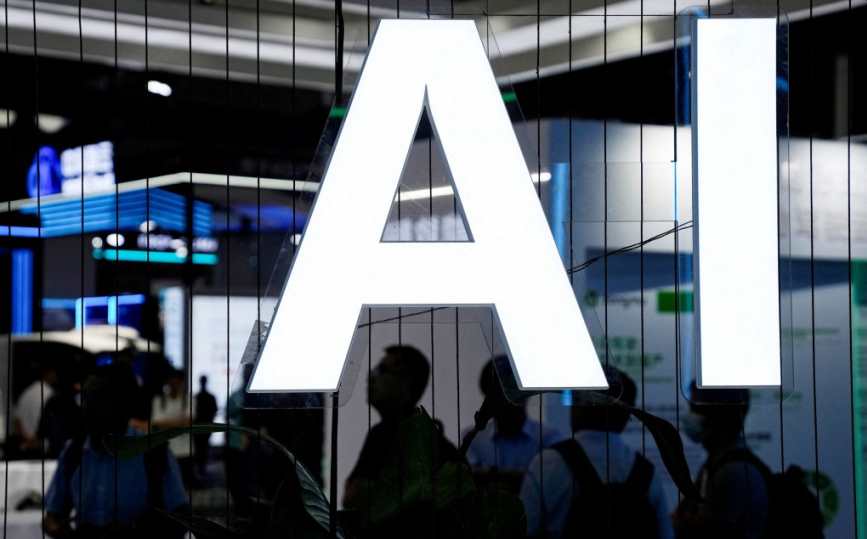
China’s rise as a producer of cheaper but capable AI models has unsettled US tech leaders and reshaped the global race for artificial intelligence.
While Washington stresses dominance and export control, Beijing is pushing open models and multilateral governance to expand its influence.
One year ago this week, the balance of confidence in global AI development was jolted by the release of China’s DeepSeek mobile app.
The model rivalled US-based systems such as ChatGPT, delivering comparable performance on key benchmarks at a fraction of the cost and using less-advanced chips.
The breakthrough shocked Silicon Valley and Wall Street, opening a new chapter in the US–China technology rivalry.
DeepSeek’s emergence forced global recognition of the competitiveness of Chinese AI models and prompted Beijing to channel more resources into building its domestic AI ecosystem.
It also sharpened Washington’s response. In its AI action plan released several months later, President Donald Trump’s administration framed the challenge bluntly, “The United States is in a race to achieve global dominance in artificial intelligence (AI).”
The plan, titled Winning the Race, America’s AI Action Plan, called for rolling back regulatory barriers seen as slowing innovation and leveraging the global reach of US technology.
It argued that, for countries willing to join America’s AI alliance, Washington should begin by exporting its full AI technology stack, including hardware, models, software, applications, and standards, in order to stop, strategic rivals from making its allies dependent on foreign adversary technology.
Around the same time, Beijing released its own Global AI Governance Action Plan, striking a markedly different tone.
The document called for building a diverse, open, and innovative AI ecosystem, emphasising the role of multiple stakeholders and urging countries to jointly promote international exchanges and dialogue on AI governance.
“China is definitely positioning itself rhetorically as a multilateral, open, and development-focused global leader,” said Scott Singer, a fellow at the Carnegie Endowment for International Peace.
He added that China’s approach increasingly resonates with global audiences with the Trump administration’s focus on AI dominance and America first.
Singer argued that Beijing’s strategy is less about outright supremacy than filling gaps left by Washington.
“If the question is, ‘is China pursuing a strategy of AI dominance,’ certainly not. It is going to seize leadership through the opportunity to fill in the gaps that the US has left in retreating from many of the spaces in the international order,” he said.
Despite the success of DeepSeek and other Chinese large language models, the United States retains a decisive advantage in computing power.
The most advanced AI chips are produced by Silicon Valley-based Nvidia, and the US remains far ahead in scaling the massive data centres required to train frontier AI systems.
China possesses deep pools of AI talent, vast datasets and abundant energy resources, but it lacks the most advanced chips.
US export controls on cutting-edge semiconductors and manufacturing equipment have preserved this gap.
Huawei’s Ascend chips, including the Ascend 910, are China’s most advanced, but tests cited by DeepSeek show they deliver only about 60 percent of the performance of Nvidia’s older H100 chips on tasks such as text generation and image classification.
These limitations are even more pronounced in training large models and building broader AI ecosystems.
Huawei is also unable to manufacture chips at the scale achieved by Nvidia, making it harder and more expensive to cluster processors to boost performance.
In December 2025, the Trump administration announced a partial reversal, allowing sales of Nvidia’s H200 chips to vetted Chinese buyers while withholding the most advanced Blackwell and Rubin chips.
Critics warned that the H200 remained highly capable and could narrow the US lead.
Chinese firms including Alibaba, Tencent and ByteDance have reportedly ordered more than two million H200 chips.
However, shipments are currently blocked, with reports that customs officials have instructed companies not to buy them.
Even so, China’s AI sector is advancing rapidly through good enough models. Open-weight systems such as DeepSeek, Moonshot AI and Alibaba’s Qwen allow developers to build applications cheaply and at scale.
Alibaba’s Qwen family has become the world’s most downloaded open-weight model, with around 700 million downloads, and the company says its models have spawned more than 180,000 derivative versions.
As Washington and Beijing pursue contrasting strategies, the global AI race is no longer just about who builds the best models, but who defines the rules, standards and alliances shaping artificial intelligence’s future.































Comments
Sign in with Google to comment, reply, and like comments.
Continue with Google